The Ultimate Guide to Ad-Supported Streaming Services in 2026: Everything You Need to Know
If you live in the United States, you already know the frustration of opening your monthly entertainment bills. Between continuous price hikes for Netflix, Disney+, Max, and live TV packages like YouTube TV, American households are facing severe “subscription fatigue”. Paying $15 to $20 a month for four or five different platforms adds up to over $100 monthly just for home entertainment. That is precisely why millions of US cord-cutters are shifting their attention back toward ad supported streaming services as a smart, budget-friendly alternative.
By embracing modern ad-supported streaming services, viewers gain access to thousands of blockbuster movies, full TV series, and live television channels without paying hefty monthly subscription fees. In this comprehensive guide, we will explore how ad-supported streaming services have revolutionized home entertainment in America, review the top platforms available today, and show you how to enjoy premium TV without breaking the bank.
1. What Are Ad-Supported Streaming Services and How Do They Work?
To understand the massive shift in modern television, it helps to look closely at the underlying technology and economic business models driving today’s media landscape. Ad-supported streaming services generally fall into two primary categories: AVOD (Advertising-Based Video on Demand) and FAST (Free Ad-Supported Streaming Television) channels.
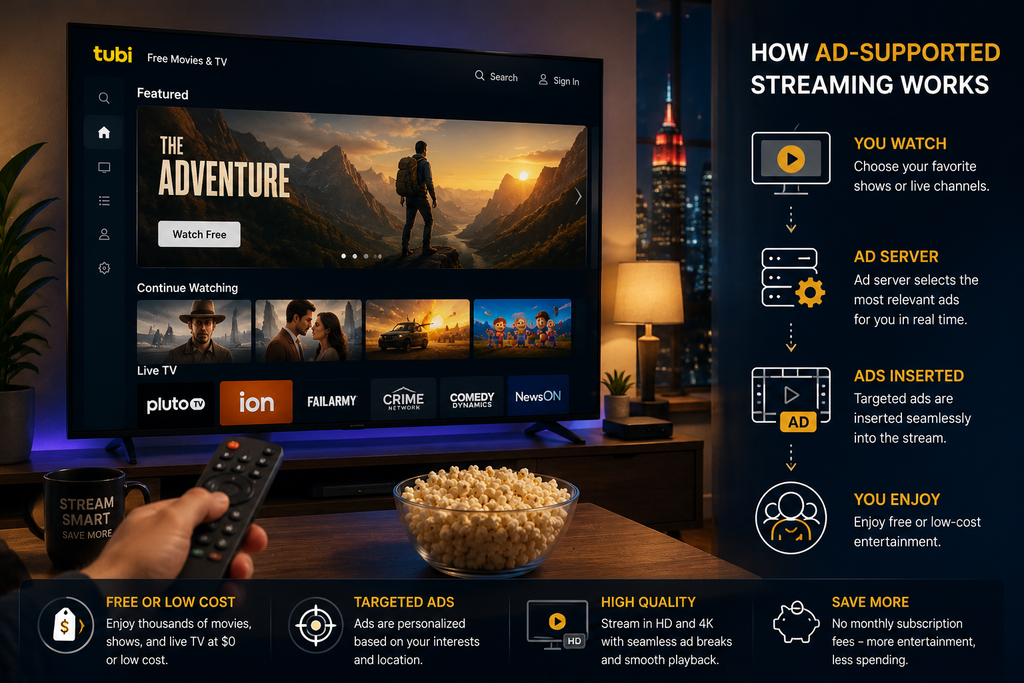
Unlike traditional subscription platforms that charge a recurring monthly fee for an ad-free experience, ad supported streaming services keep user subscription fees at $0 or heavily discounted rates by integrating commercial breaks. Behind the scenes, these platforms use advanced programmatic ad-insertion technology. When you stream a show or a live event, targeted digital commercials are dynamically injected into the video feed based on your demographic profile, viewing habits, and location in the US.
This model benefits both parties: users enjoy high-definition entertainment for free or cheap, while advertisers reach highly targeted American consumer audiences efficiently.
To fully grasp how ad supported streaming services operate, one must explore the intricate engineering and digital supply chain that takes a piece of video content and delivers it to a screen with targeted advertisements.
In a traditional television broadcast, commercials were scheduled weeks in advance for broad demographic blocks. Today, digital video broadcasting relies on Server-Side Ad Insertion (SSAI) and Client-Side Ad Insertion (CSAI) frameworks. When a viewer in Los Angeles, Chicago, or New York selects a title on platforms like Tubi or Pluto TV, the streaming application communicates with cloud-based ad servers in milliseconds. These servers evaluate real-time user metadata, device type, network parameters, and geographic location to auction and stitch a relevant commercial spot directly into the video stream before it reaches the end user’s smart television or streaming stick.
This dynamic insertion technology is what separates modern ad supported streaming services from legacy broadcast networks. Programmatic advertising platforms allow brands to bid on specific viewing slots based on precise audience segmentation. If a viewer is streaming an evening cooking show or an afternoon sports highlight reel, the ad server recognizes the context and delivers commercial spots tailored to food brands, local automotive dealers, or retail sales in that exact US ZIP code. This precision creates a highly efficient monetization pipeline, replacing the blanket advertising approach of old-school cable with hyper-relevant digital messaging.
Furthermore, the economic architecture of ad supported streaming services directly addresses the financial strain of modern media consumption. Over the past decade, American households grew accustomed to accumulating multiple standalone streaming applications. However, as subscription fatigue set in and monthly expenses climbed past the cost of old cable bills, consumers began actively looking for alternatives that do not require continuous credit card commitments.
By absorbing the cost of content acquisition and server hosting through commercial revenue, ad supported streaming services democratize access to premium entertainment. Households can enjoy thousands of hours of studio-released movies, syndicated television series, and live linear feeds without managing multiple recurring billing cycles or worrying about unexpected subscription price hikes.
As this market continues to mature, ad supported streaming services are also heavily investing in user experience optimization. Early iterations of free streaming apps often suffered from repetitive commercial loops, unpredictable audio volume shifts during ad breaks, and long buffering pauses. Today’s leading platforms utilize advanced cloud transcoders and adaptive bitrate streaming protocols to ensure that the transition between main content and commercial pods is completely seamless. The commercial breaks are formatted to match the native resolution and frame rate of the video stream—whether 720p, 1080p, or 4K Ultra HD—delivering a polished, television-grade presentation that keeps viewers engaged from start to finish.
2. The Evolution of TV: From Traditional Cable to Ad-Supported Streaming Services
For decades, traditional cable television relied entirely on commercial breaks to fund broadcasting operations. However, cable bundles became bloated with unwanted channels, equipment rental fees, and hidden broadcast surcharges. When early streaming apps like Netflix launched ad-free, consumers rejoiced—until subscription prices skyrocketed.
The market has now come full circle. Today’s ad supported streaming services combine the financial accessibility of traditional commercial television with the on-demand convenience of modern digital streaming. Advertisers have shifted billions of dollars in ad spend away from declining cable networks and directly into ad supported streaming services, recognizing that modern US audiences spend the vast majority of their screen time on connected TV (CTV) devices.
3. Top Free Ad-Supported Streaming Services in the USA (FAST Channels)
If you want to eliminate monthly subscription costs entirely, several major platforms offer massive libraries of movies and live channels completely free of charge:
Tubi: Owned by Fox Corporation, Tubi is widely considered one of the best ad-supported streaming services in the US, offering over 50,000 movies, TV shows, and live local news feeds without requiring a credit card or subscription signup.
Pluto TV: Operating like a digital cable box, Pluto TV pioneered the FAST model with hundreds of live, linear channels dedicated to specific genres, classic TV shows, reality series, and 24/7 movie streams.
The Roku Channel: Built directly into millions of Roku devices and available on other platforms, this service provides free live TV, hit movies, and exclusive Roku Originals through ad-supported streaming services.
Amazon Freevee (formerly IMDb TV): Integrated seamlessly into the Amazon Prime Video app, Freevee delivers premium original series and licensed Hollywood movies supported by short ad breaks on leading ad-supported streaming services.
4. Premium Hybrid Platforms: Paid Subscriptions Meet Ad-Supported Streaming Services
If you still want access to brand-new theatrical releases and prestige television series but hate paying top-dollar for ad-free tiers, premium hybrid ad supported streaming services offer the perfect middle ground:
- Hulu (Ad-Supported): The pioneer of the hybrid model, offering full access to next-day network television broadcasts and award-winning FX series at a significantly lower monthly cost.
- Netflix & Disney+ Standard with Ads: Facing market saturation, both streaming giants introduced ad supported streaming services tiers that let subscribers enjoy top-tier original content at a fraction of the premium price.
- Max & Paramount+ Ad Tiers: These platforms provide blockbuster movies, live sports add-ons, and live news feeds through cost-effective ad supported streaming services options.
5. Sports, News, and Live Events on Ad-Supported Streaming Services

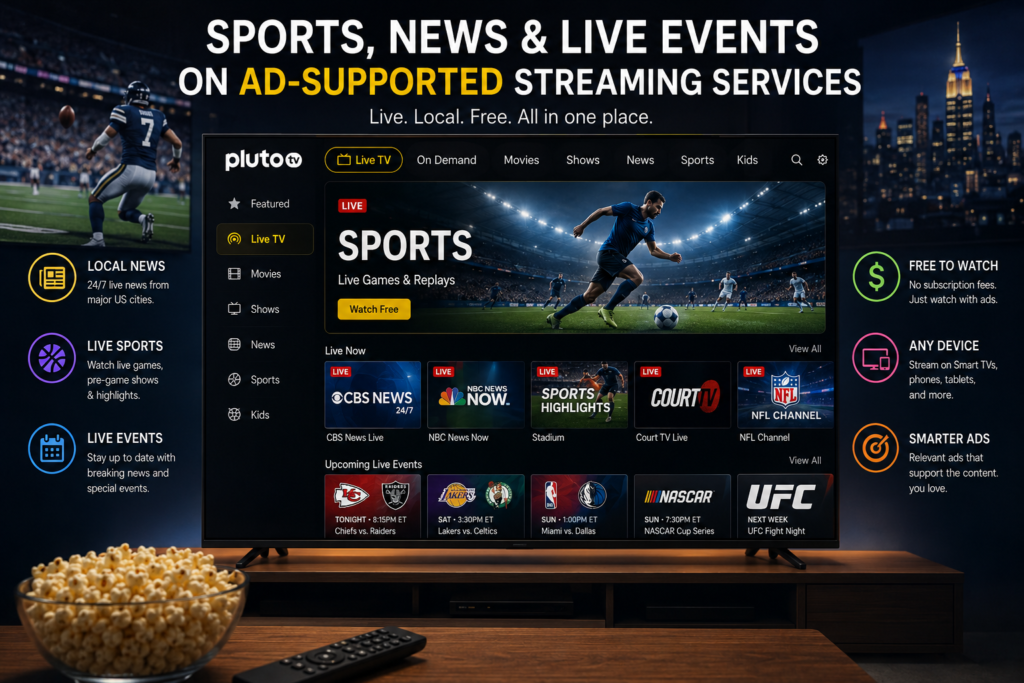
One of the biggest historical drawbacks of free or cheap streaming was the lack of live sports and breaking news. However, modern ad supported streaming services have aggressively expanded into live broadcasting:
- Local US News Feeds: Platforms like Tubi, Pluto TV, and The Roku Channel now feature dedicated 24/7 live feeds from major US metropolitan areas (New York, Los Angeles, Chicago, Miami, Dallas).
- Live Sports & Replays: Major leagues are partnering with ad supported streaming services to stream select games, pre-game shows, and highlights for free, helping leagues reach younger, cord-cutting demographics who do not subscribe to traditional cable bundles.
6. User Experience & Ad Load: Managing Commercials in Modern Streaming
A common concern among viewers is whether ad supported streaming services will flood their screens with long, repetitive commercial breaks reminiscent of old-school cable TV. Fortunately, digital streaming ad loads are much shorter and smarter.
While traditional cable often forced viewers through 4 to 5 minutes of commercials every 12 minutes, top-tier ad supported streaming services typically limit commercial breaks to 60 or 90 seconds. Furthermore, advanced ad-tech ensures that you see fewer repeated commercials, resulting in a much cleaner, less frustrating viewing experience.
7. Device Compatibility: Where to Watch Ad-Supported Streaming Services in the USA
Another major advantage of ad supported streaming services is universal hardware compatibility across American households. You do not need specialized hardware or rented cable boxes; you can simply download the apps directly onto:
- Streaming Sticks: Amazon Fire TV Stick, Roku 4K, and Apple TV 4K.
- Smart TVs: Modern Samsung, LG, Sony, and Vizio televisions running built-in app stores.
- Mobile Devices & Tablets: iOS and Android devices for entertainment on the go.
- Web Browsers: Instant streaming directly from your laptop or PC.
8. Data Privacy and Targeted Advertising on Ad-Supported Streaming Services
Because ad supported streaming services rely on commercial revenue rather than traditional subscription fees, they utilize detailed viewing analytics to serve relevant ads. When using these platforms in the USA, providers collect anonymous data regarding which genres you watch, what time of day you stream, and your general geographic region. Most major ad supported streaming services allow users to adjust their privacy and ad-personalization preferences directly within the account settings menu.
To maintain free or deeply discounted subscription tiers, modern streaming platforms must monetize user attention through targeted advertising. Unlike traditional linear television, which broadcasted identical commercials to every household regardless of demographics, connected TV (CTV) environments leverage sophisticated tracking mechanisms.
As you navigate through menus, select genres, and stream content across US households, algorithms record viewing patterns, interaction rates, and completion metrics. This data allows brands to tailor commercials specifically to regional preferences, household interests, and viewing habits, ensuring a higher return on investment for advertisers while subsidizing the cost of entertainment for everyday viewers.
However, this data-driven monetization model operates under an increasingly strict regulatory framework across the United States. Federal and state laws—such as the California Consumer Privacy Act (CCPA) and various emerging state-level privacy statutes—place heavy obligations on streaming operators regarding how user data is gathered, stored, and shared with third-party ad exchanges. Under these regulations, platforms operating within the US must provide clear transparency regarding their data collection practices. This includes tracking device identifiers, IP addresses, and specific show titles watched on connected TV apps.
Consequently, major providers of ad supported streaming services have built robust compliance tools into their user interfaces, allowing consumers to review data-sharing agreements and opt out of cross-context behavioral advertising if they choose.
In addition to state-level consumer privacy laws, ad supported streaming services must strictly navigate federal regulations protecting minors, notably the Children’s Online Privacy Protection Act (COPPA). When general-audience streaming apps host family content or cartoon programming, they are legally barred from harvesting persistent identifiers, tracking user behavior, or building ad-profiling portfolios for children under the age of 13.
To stay compliant, leading platforms automatically disable behavioral tracking on dedicated kids’ profiles or shift entirely to contextual advertising—where commercials match the immediate program on screen rather than tracking the user across multiple sessions. This ensures that younger audiences enjoy a safe viewing environment protected from aggressive digital surveillance.
For adult users who wish to balance personalized recommendations with data privacy, managing these settings is straightforward. Most popular ad supported streaming services feature a dedicated “Privacy” or “Ad Preferences” tab nested directly within the account management dashboard or TV app settings. By navigating to this menu, viewers can toggle off personalized ad targeting, restrict data sharing with external marketing partners, or reset their advertising IDs. While opting out of personalized ads does not eliminate commercials entirely—you will still see ad breaks, though they may be less tailored to your specific shopping habits—it gives American consumers complete control over their digital footprint while continuing to enjoy the financial benefits of ad-supported streaming services.
9. The Future of TV: Will Ad-Supported Streaming Services Completely Replace Cable?
The transition of American television away from rigid cable contracts and clunky set-top boxes is virtually complete. For decades, legacy providers like Comcast Xfinity, Spectrum, and DirecTV held a near-monopoly on living room entertainment, forcing households into bloated, expensive bundles filled with hundreds of unwatched channels.
Today, as subscription costs for standalone ad-free video-on-demand apps continue to climb and cause widespread “subscription fatigue,” ad-supported streaming services are positioned to become the dominant model for home entertainment. By offering an unbeatable combination of zero subscription fees, massive on-demand libraries, and modern user interfaces, ad-supported streaming services guarantee that television remains accessible and affordable for every household.
To truly understand why ad supported streaming services are reshaping the modern media ecosystem, we must examine how consumer behavior has shifted across the United States. Recent media consumption data indicates that streaming has decisively outpaced traditional cable and broadcast television combined. Millions of American households have officially crossed the threshold into cord-cutting, making non-pay-TV homes the new majority.
Within this rapidly evolving landscape, ad supported streaming services act as the primary catalyst, capturing billions of hours of viewing time because they solve the core financial burden of modern entertainment. Instead of forcing users to choose between paying $100+ a month across five different streaming platforms or missing out entirely, ad supported streaming services reintroduce the familiar, frictionless economics of commercial television—funded by brands rather than heavy consumer invoices.
Furthermore, the technological infrastructure powering ad supported streaming services has evolved far beyond the clunky, interruptive commercial breaks of old-school cable. Modern connected TV (CTV) environments utilize sophisticated programmatic ad tech, ensuring that commercials are relevant, tightly targeted, and significantly shorter. When viewers tune into ad supported streaming services, they encounter dynamic ad insertion that respects the viewing experience, limiting ad pods to manageable 60-to-90-second intervals.
This delicate balance allows platforms to maintain zero-dollar subscription tiers while funding high-budget Hollywood productions, prestige dramas, and expanding live news broadcasts. Consequently, advertisers are rapidly redirecting billions of dollars in ad spend away from declining linear networks and directly into ad supported streaming services, securing a stable, long-term financial engine for the entire industry.
Another critical factor driving the permanent dominance of ad supported streaming services is the integration of live programming, local news, and sports content. Historically, free streaming apps were limited to older movie catalogs and syndicated rerun shows.
Today, leading ad-supported streaming services feature hundreds of Free Ad-Supported Streaming Television (FAST) channels that broadcast live local news updates from major US metropolitan areas, real-time weather reports, and dedicated sports highlights. By bridging the gap between on-demand convenience and live broadcasting, ad-supported streaming services eliminate the last remaining functional argument for keeping traditional cable alive. Viewers no longer need a bulky cable box just to catch breaking news or weekend sports coverage.
As we look further into the decade, the synergy between hardware manufacturers and ad-supported streaming services will only tighten. Smart TV manufacturers like Samsung, LG, Vizio, and streaming device giants like Roku and Amazon are pre-installing ad-supported streaming services directly into the home screen operating systems of their devices.
This zero-friction accessibility means that a user unpacking a new television in an American living room can instantly access thousands of channels and movies within seconds, completely bypassing app stores, credit card inputs, or account registrations. This native hardware integration cements ad-support streaming services as the default utility layer of modern television.
Ultimately, the question of whether ad-supported streaming services will completely replace cable has already been answered by the market itself. Traditional cable is fading into a legacy niche, while ad supported streaming services continue to expand their content libraries, technological capabilities, and audience share year after year. By uniting financial freedom, expansive entertainment catalogs, and seamless device compatibility, ad-supported streaming services ensure that the future of television is open, democratic, and built for everyone.
Frequently Asked Questions (FAQ)
Do I need to pay a monthly fee to use ad-supported streaming services?
No. Platforms like Tubi, Pluto TV, and The Roku Channel are 100% free ad-supported streaming services that never require a credit card or subscription fee.
Can I watch live local news on ad-supported streaming services?
Yes! Many top ad supported streaming services include dedicated live news channels covering local broadcasts from major American cities, weather reports, and national headlines.
Are ad loads annoying on ad-supported streaming services?
Not at all. Commercial breaks on modern ad-supported streaming services are typically much shorter (around 60 to 90 seconds) than traditional cable TV advertisements, keeping the viewing experience smooth and engaging.